Rotary vs coil tattoo machines: an honest comparison
The rotary-versus-coil debate has calmed down: rotaries dominate modern studios, yet coils refuse to disappear. That is because the two machines feel genuinely different to work with — and "better" depends on what you are asking the machine to do.
Weight, noise, maintenance, tuning and the way each machine hits — where rotaries genuinely win, where coils still earn their keep, and how to choose for your style.
How each machine moves the needle
A rotary uses an electric motor spinning a cam: rotation becomes a smooth, constant up-and-down stroke. A coil uses two electromagnetic coils that snap an armature bar down and release it — a sharper, percussive hit with a distinctive buzz. That mechanical difference explains almost everything downstream: sound, weight, maintenance and the feel of the hit.
| Criterion | Rotary / pen | Coil |
|---|---|---|
| Hit character | Constant, smooth | Percussive, harder "punch" |
| Weight | Light (often under 150 g) | Heavier (typically 200 g+) |
| Noise & vibration | Quiet, minimal | Loud buzz, noticeable vibration |
| Maintenance | Minimal — occasional service | Regular tuning: springs, contact screw, gaps |
| Versatility | One machine can line and shade | Usually tuned as a dedicated liner or shader |
| Needle format | Cartridges (typically) | Bar needles and tubes |
| Learning curve | Gentle | Steeper — tuning is a skill in itself |
Where rotaries win
- Comfort: light weight and low vibration mean less hand fatigue across long sessions — your last hour looks like your first.
- Simplicity: no springs to tune, no contact gaps to set; charge or plug in and work.
- Versatility: with adjustable stroke or sensible needle choices, one rotary covers lining, shading and colour.
- Cartridge workflow: quick needle changes and a fully disposable hygiene chain.
- Quiet running: some clients genuinely relax more without the coil buzz.
Where coils still earn their keep
- The hit: a well-tuned coil liner drives dense groupings through skin with an authority some artists never find in rotaries.
- Feedback: coils telegraph what the needle is doing through sound and feel — experienced hands read that signal constantly.
- Adjustability: everything is tunable — speed, hardness, give — if you have the knowledge.
- Tradition: many artists trained on coils simply work best on them, and traditional-style studios keep the craft alive.
Starting today, buy a rotary — pen format, medium stroke — and spend your energy on technique rather than machine tuning. Add a coil later if your style pulls you towards bold traditional work, or if you fall in love with the feel. There is no prize for suffering with the harder tool first.
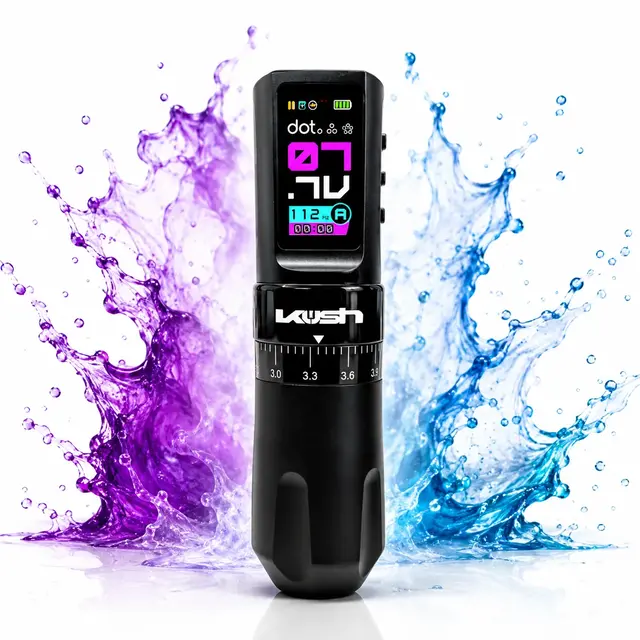
Machines in the catalogue



Cost of ownership, honestly
A quality rotary pen costs more upfront than an entry coil, but the total picture narrows: coils want spare springs, capacitors and periodic tuning time, and run bar needles with tubes that either cost per session (disposable) or demand an autoclave (reusable). Rotaries mostly want cartridges and the occasional service. Neither is dramatically cheaper over a working year — choose on feel and workflow, not on the price tag alone.
Frequently asked questions
Is a rotary or coil machine better for beginners?+
A rotary — almost without exception. It is lighter, quieter, needs no tuning knowledge, works with cartridges, and lets a beginner spend their attention on needle depth and hand speed instead of machine mechanics.
Do professionals still use coil machines?+
Yes. Plenty of experienced artists — especially in bold traditional styles — prefer the percussive hit and the feedback of a well-tuned coil. It is a legitimate preference, not nostalgia; it is simply a harder tool to start on.
Can one rotary machine do both lining and shading?+
Yes — that versatility is a core rotary advantage. With an adjustable stroke, or a fixed medium stroke around 3.5 mm plus appropriate needle choices, a single rotary pen handles lining, shading and colour packing competently.
Why are coil machines so loud?+
The buzz is the electromagnetic cycle itself: coils snapping the armature bar down and a spring releasing it, dozens of times per second. It is inherent to the design — part of the charm for some, a reason to go rotary for others.