How to choose your first rotary tattoo machine
Your machine is the tool you will hold for thousands of hours, so it is worth choosing carefully — but the right choice has less to do with brand names and more to do with matching the machine's character to the work you want to do.
Stroke length, give, weight, wireless or wired — what actually matters when buying your first rotary or pen, explained without the marketing noise, plus the mistakes to avoid.
Rotary, pen — what's the difference?
Both are rotary machines: a motor spins a cam that converts rotation into the up-and-down movement of the needle. A "pen" simply packages that motor into a stylus-shaped body, so you hold it exactly like a thick pen. Pens take cartridges natively, balance naturally in the hand, and are the most intuitive format for someone starting out. Classic rotary formats (direct drive, slider) offer the same motion in a more traditional body.
The specifications that actually matter
Stroke length
Stroke is how far the needle travels on each cycle. A shorter stroke (around 2.5–3.2 mm) hits softly and frequently — forgiving for shading and colour. A longer stroke (3.5–4.2 mm) hits harder per cycle — better for crisp lines and solid packing. A 3.5 mm stroke is the classic all-rounder, and several machines now offer adjustable or swappable strokes so one body covers everything.
Give
Give is how much the mechanism "yields" when the needle meets resistance. Soft give is forgiving — it cushions overworking and is kinder to skin while you develop hand control. Hard give (or no give) transmits everything directly, which experienced artists prize for precision. As a beginner, softer give will flatter your learning curve.
Weight and balance
A heavy machine tires your hand within a couple of hours, and fatigue shows in your lines long before it shows in your wrist. Under about 150 g (without battery) is comfortable for most hands; also check the grip diameter — most pens take 32–38 mm grips, and the right thickness is personal.
Power: wired or wireless
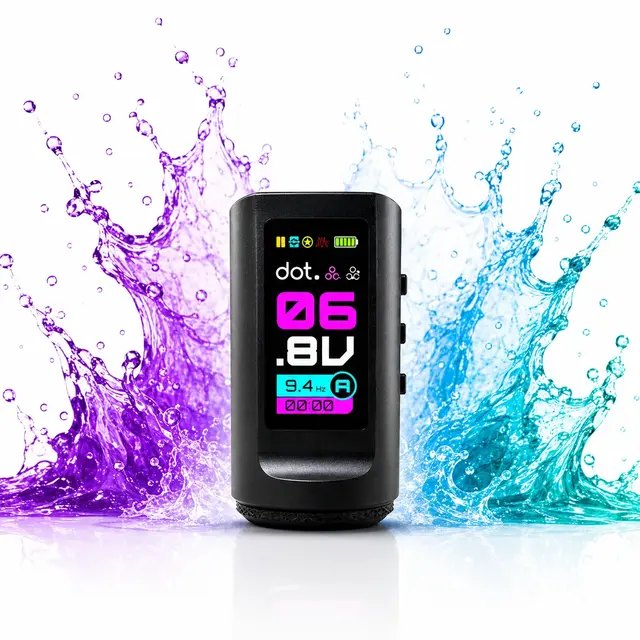
Wired machines run from a power supply with rock-steady voltage and no battery anxiety. Wireless machines swap the cable for a battery pack — extraordinary freedom of movement, at the cost of charge management. Many current machines are convertible: battery on the back, or a cable when you prefer. If you go wireless, check the battery is replaceable and a spare is affordable.
| You mostly want to do | Stroke | Give | Format |
|---|---|---|---|
| A bit of everything (learning) | 3.5 mm | Soft–medium | Pen, wired or convertible |
| Fine line, script, delicate work | 2.5–3.0 mm | Soft | Light pen |
| Bold traditional, heavy lining | 4.0 mm+ | Hard | Pen or direct-drive rotary |
| Black & grey realism | 3.0–3.5 mm | Soft | Pen, wireless helps mobility |
A cartridge pen with a ~3.5 mm stroke, soft-to-medium give and a weight under 150 g, powered by a stable supply, is the safest first buy. It will let you learn lining and shading on one tool and stay useful for years as a second machine.
Rotary machines and pens in the catalogue
Budget honestly
- Entry level: a dependable learning machine. Expect basic bearings and a fixed stroke — fine for artificial skin and your first supervised work.
- Mid-range: better motors, quieter running, often adjustable stroke — the sweet spot for a working apprentice.
- Professional: premium pens from brands like Cheyenne or Bishop — refined balance, longevity and spare-part availability. They earn their price over daily use, not on day one.
- Whatever the tier, budget for a decent power supply — unstable voltage sabotages a good machine faster than any other false economy.
Mistakes we see beginners make
- Buying the cheapest kit bundle: the machine is usually the weakest part and the inks in bundles are rarely traceable.
- Choosing by Instagram hype instead of stroke and give.
- Ignoring ergonomics — a machine you cannot hold comfortably for three hours is the wrong machine at any price.
- Skipping the power supply and running from an unregulated adapter.
Frequently asked questions
What is a good first tattoo machine for a beginner?+
A cartridge pen with a medium (~3.5 mm) stroke, soft-to-medium give and a weight under about 150 g, run from a stable power supply. It is versatile enough to learn both lining and shading and remains useful as a backup later.
What stroke length should I choose?+
3.5 mm is the classic all-rounder. Shorter strokes (2.5–3.2 mm) hit softly and suit shading and fine work; longer strokes (4 mm+) hit harder and suit bold lines and solid colour. Adjustable-stroke machines cover all of it in one body.
Is a wireless machine worth it for a beginner?+
It is convenient, but not essential. Wired machines give perfectly stable voltage and one less thing to manage while you learn. If you do buy wireless, choose one with a replaceable battery and buy a spare.
Do expensive machines make you a better artist?+
No — they reward skill you already have with consistency, comfort and durability. A mid-range pen with good technique will always beat a premium pen with poor technique. Invest in practice materials as much as hardware.