Tattoo ink types and greywash dilution: a practical guide
Ink is pigment suspended in a carrier — that is the whole product. But the way pigment load, particle size and carrier are balanced makes one black perfect for lines and another perfect for smooth grey. Understanding that balance is what lets you buy less and use it better.
Lining blacks, shading blacks, colour sets and greywash — what is actually in the bottle, how dilution works, and how to build a small ink shelf that covers real work.
What is in a bottle of tattoo ink
Every ink has two parts: pigment (the colour) and carrier (the liquid that delivers it — typically water, glycerine, witch hazel and/or alcohol). A high pigment load with a thicker consistency saturates fast; a lighter load flows and layers more gently. Reputable manufacturers list ingredients on the label, print batch numbers and expiry dates, and state their compliance with the EU REACH ink restriction — which has become the de facto quality benchmark for inks sold in the UK too.
The types you will actually use
Lining black
Dense, high pigment load, slightly thicker body. Built to go in dark in one pass and stay crisp as it heals. Brands known for blackwork — Panthera is the classic example — build their reputation on exactly this bottle.
Shading black and greywash
A shading black is formulated to dilute predictably. Greywash is that same idea pre-packaged: a graded set (often light, medium, dark) that gives you repeatable values without mixing at the station. Pre-mixed washes cost more per bottle but buy you consistency — the same "light" today, next week, and on the healed result.
Colour sets
Start small: a primary set of 6–12 colours mixes into most of what you need. Full 50-shade walls look great on shelves and expire in drawers. White deserves a slot of its own — for highlights and for cutting colours into pastels.
Greywash dilution, demystified
Greywash is black ink diluted with distilled water or a dedicated mixing solution. Artists describe strengths in ratios — one part ink to N parts dilutant. There is no single "correct" recipe, but a classic homemade ladder looks like this:
| Step | Ratio | Reads as |
|---|---|---|
| Dark | 1:1 | Deep shadow, close to solid black |
| Medium | 1:2 | Core mid-tone |
| Light | 1:4 | Soft transition tone |
| Whisper | 1:8 | Barely-there mist, skin-tone edges |
- Mix with distilled water or a purpose-made mixing solution — never tap water, which is neither sterile nor consistent.
- Mix in disposable cups at the station, or in sealed bottles if you prepare a house ladder — label ratios and dates.
- Test your ladder on artificial skin first: healed values on real skin sit lighter than they look wet.
- Whip shading with a lighter wash builds smoother gradients than forcing a dark wash to behave.
If consistency across sessions matters more to you than cost, buy a pre-mixed greywash set. If you enjoy controlling values and work varied styles, mix your own ladder from one good shading black — it is cheaper and infinitely adjustable. Many artists do both: bottles for the core values, cup-mixing for edges.
Blacks and greywash in the catalogue
Vegan inks and what the label tells you
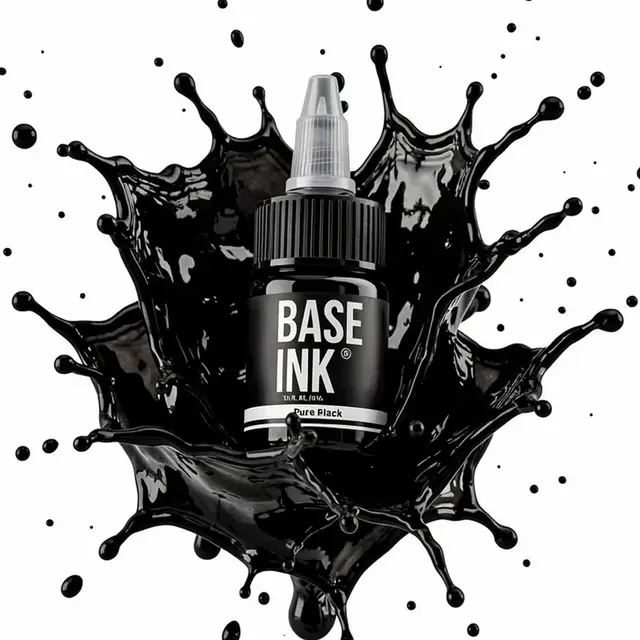
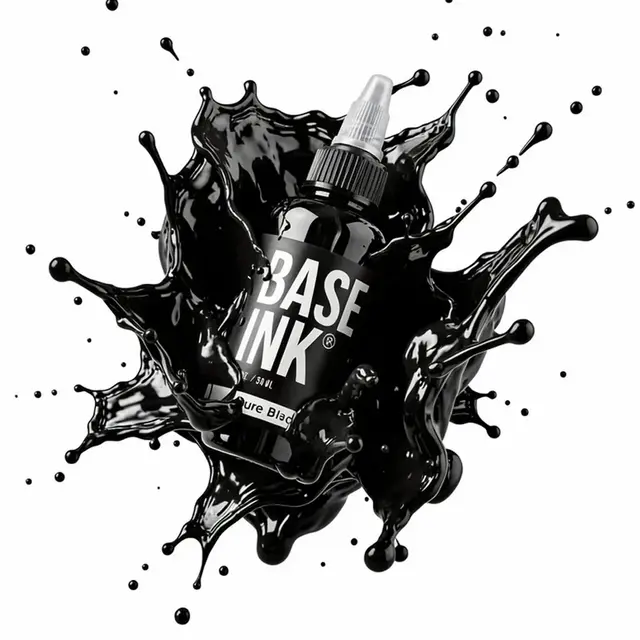
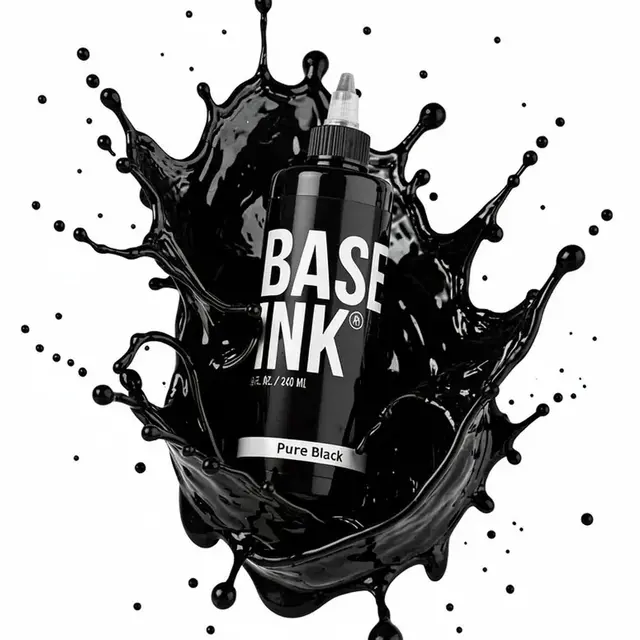
- Many professional inks today are vegan — no animal-derived glycerine, bone char or shellac — and labelled as such. Base Ink and Balm Tattoo, for example, position their ranges this way; check each product's own label rather than assuming.
- Look for: full ingredient list, batch/lot number, expiry date, sterile seal, and a REACH compliance statement.
- Avoid: unlabelled bottles, resold or decanted ink, and anything without a traceable manufacturer.
Handling ink well at the station
- Shake thoroughly before use — pigment settles, and the first pour from an unshaken bottle is mostly carrier.
- Pour into single-use ink caps; never dip a used needle back towards the bottle.
- Recap promptly and store away from sunlight and heat — more on storage in our dedicated article.
- Note opening dates on bottles; most manufacturers advise using an opened bottle within a stated period.
Frequently asked questions
What is the difference between lining black and shading black?+
Lining black has a high pigment load and thicker body so lines go in dark and crisp in one pass. Shading black is formulated to dilute predictably into smooth grey values. You can shade with a diluted lining black, but a dedicated shading black behaves more consistently.
How do I mix greywash and in what ratios?+
Dilute a shading black with distilled water or a dedicated mixing solution. A classic ladder is 1:1 (dark), 1:2 (medium), 1:4 (light) and 1:8 (very light) — ink to dilutant. Ratios are a starting point: test on artificial skin and adjust to how your values heal.
Are vegan tattoo inks as good as regular inks?+
Yes — vegan formulation refers to the carrier and processing ingredients, not the quality of pigment. Many leading professional inks are vegan as standard. Judge any ink by its ingredient transparency, batch traceability and REACH compliance.
How many colours do I actually need to start?+
A primary set of 6–12 colours plus a good lining black, a shading black or greywash set, and a white will cover most work. Colours mix; expiry dates do not negotiate. Buy small, use fresh, expand as your style demands.